Microeconomics → International Trade → Tariffs | Part 3 of 4
Part 3 of our four-part tariff learning pathway. Build the tariff diagram step by step and understand how a tariff affects domestic prices, production, consumption and imports.
In the previous article, World Price and Imports Explained: The Economics Before a Tariff, we built the basic free-trade diagram.
At the world price, British consumers wanted to buy more tomatoes than British producers wanted to supply. The gap between the two was filled by imports.
Now we change just one thing.
The government imposes a tariff on imported tomatoes.
That affects the price in the domestic market, the amount British producers supply, the amount consumers buy and, ultimately, the quantity imported.
Start with the world-price diagram
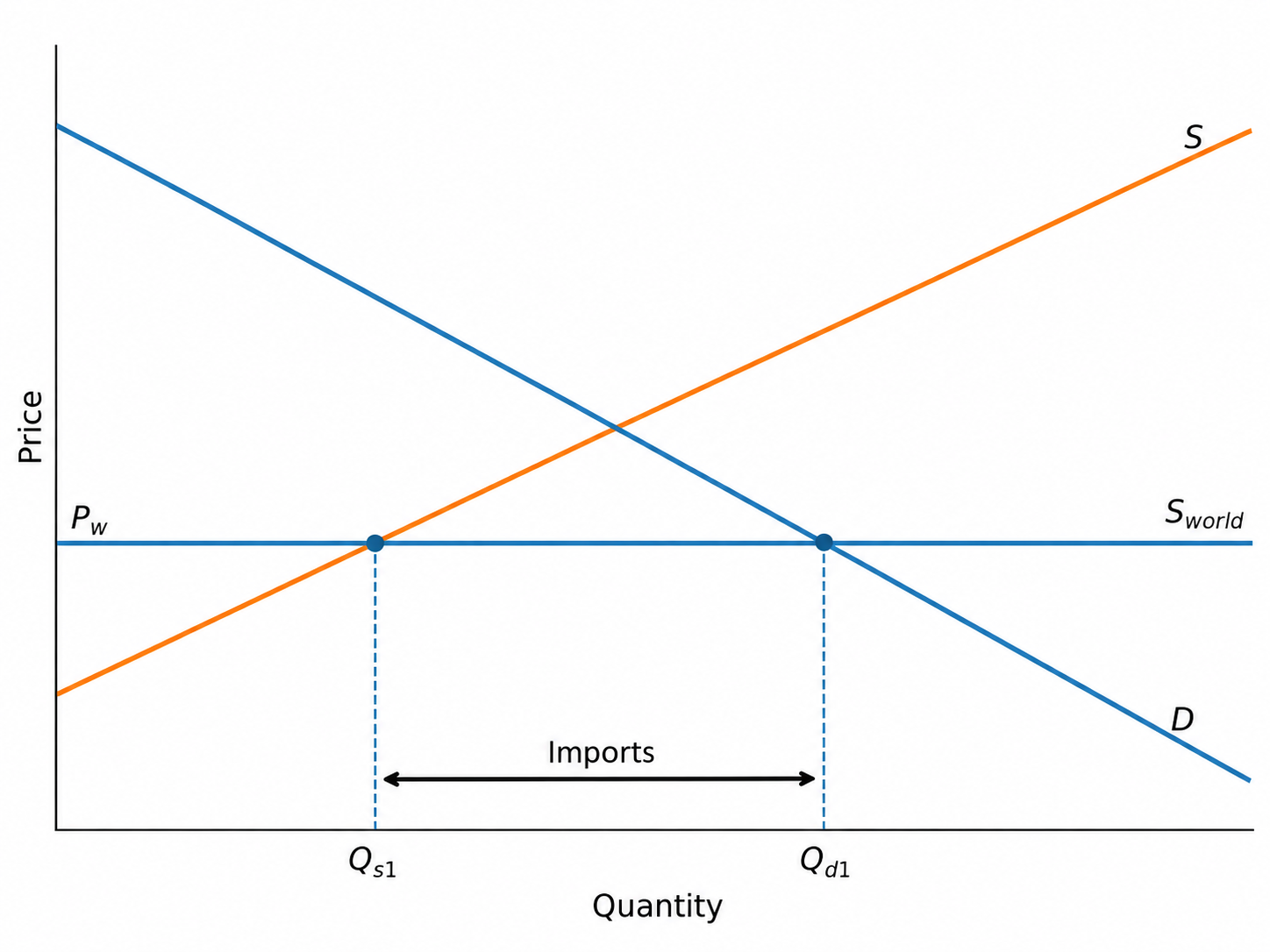
Before the tariff, imported tomatoes are available at the world price, Pw.
In the standard small-country model, Britain is a price taker. Its purchases are too small to change the world price, so foreign suppliers are treated as willing to supply as much as Britain wants at Pw.
The horizontal line at Pw therefore represents a perfectly elastic world supply curve, sometimes labelled Sworld.
At Pw:
British producers supply Qs1
British consumers demand Qd1
the difference between them is imports
So:
Imports = Qd1 - Qs1
This is our starting point.
Now add a tariff
A tariff is a tax on imports.
Suppose the government imposes a tariff of “t” on each unit imported.
The world price itself does not change. It remains Pw.
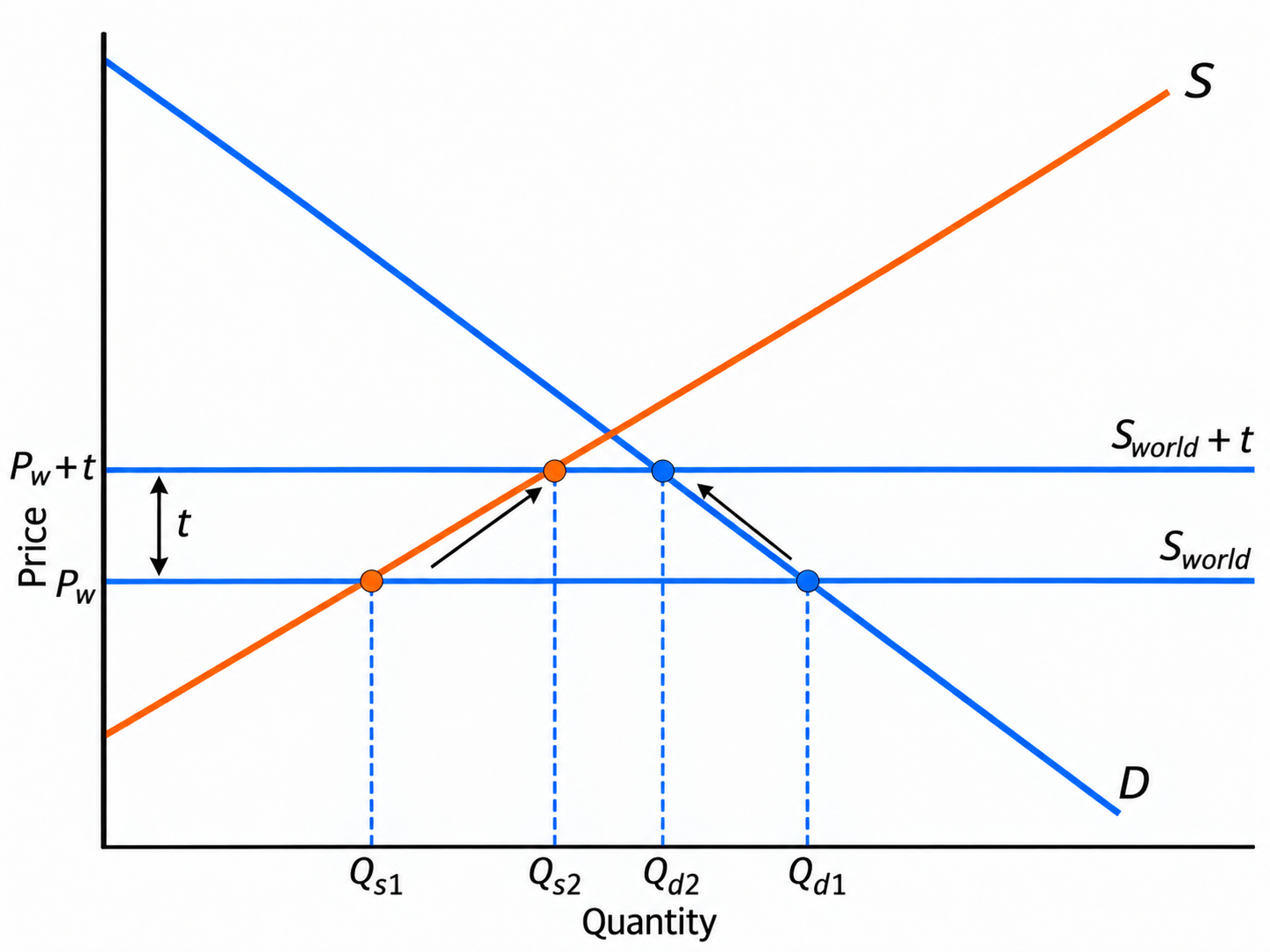
But imported tomatoes now enter the British market at a higher tariff-inclusive price:
Pw + t
On the diagram, this is shown by a second horizontal line above Pw. It may also be labelled Sworld + t.
In the diagram we are using, the tariff is not high enough to stop imports altogether. Imports continue after the tariff is imposed.
Why does the domestic price rise?
Before the tariff, imported tomatoes were available at Pw.
If British producers tried to charge more than Pw, supermarkets could buy equivalent imported tomatoes instead.
Once the tariff is imposed, imported tomatoes cost Pw + t to bring into Britain.
British producers can therefore charge up to Pw + t while remaining competitive with imports.
In the standard model, competition therefore pins the domestic price at Pw + t.
The chain is:
Tariff → imported goods enter at a higher price → domestic price rises
The higher domestic price then changes the behaviour of both producers and consumers.
What happens to domestic producers?
At the higher domestic price, British producers are willing to supply more tomatoes.
Quantity supplied rises from Qs1 to Qs2.
This is an expansion in quantity supplied along the domestic supply curve. The supply curve itself has not shifted.
Some British production that was not profitable at Pw becomes profitable at Pw + t.
Domestic production therefore rises.
What happens to consumers?
Consumers also face the higher domestic price.
At that price, they buy fewer tomatoes.
Quantity demanded falls from Qd1 to Qd2.
This is a contraction in quantity demanded along the demand curve. The demand curve itself has not shifted.
So the same price rise produces two responses:
domestic producers supply more;
consumers buy less.
Those two changes reduce imports.
Why do imports fall?
Before the tariff: Imports = Qd1 - Qs1
After the tariff: Imports = Qd2 - Qs2
The second gap is smaller.
Imports fall for two reasons at the same time:
Quantity supplied by British producers rises.
Quantity demanded by British consumers falls.
That is the central mechanism in the tariff diagram.
It is not enough simply to write:
tariff → imports fall
A stronger explanation is:
The tariff raises the domestic price. Quantity supplied by domestic producers rises while quantity demanded by consumers falls. The gap between domestic demand and domestic supply therefore narrows, so imports fall.
Once you understand what happens at each end of the import gap, the fall in imports no longer has to be memorised.
The full tariff diagram
The complete diagram now brings the whole mechanism together.
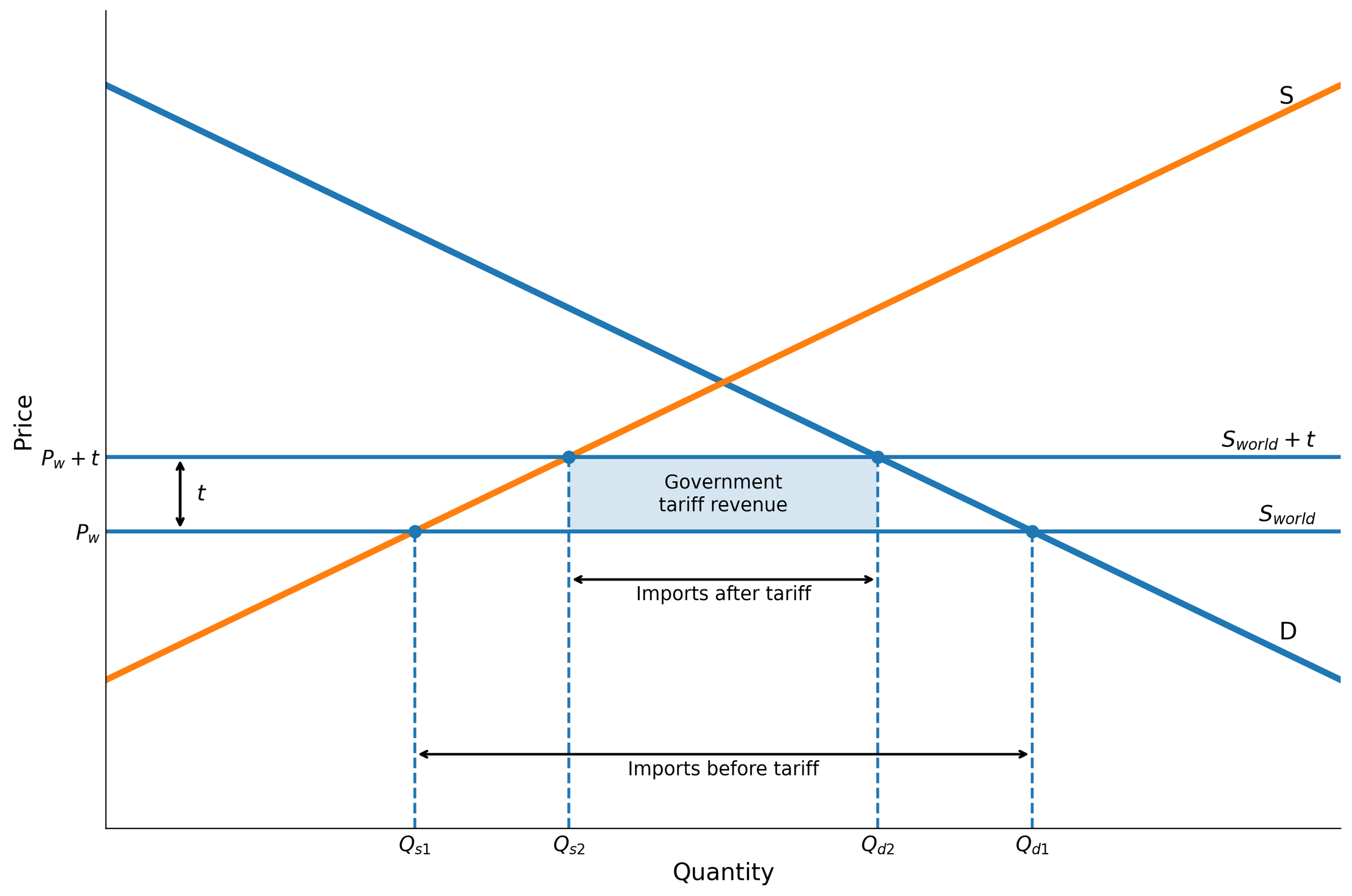
It shows:
the original world price, Pw;
the tariff-inclusive domestic price, Pw + t;
domestic production rising from Qs1 to Qs2;
domestic consumption falling from Qd1 to Qd2;
imports shrinking from Qd1 − Qs1 to Qd2 − Qs2.
The vertical distance between Pw and Pw + t is the tariff per unit.
Where does the tariff money go?
The tariff is paid to the government on the imports that remain after the tariff is imposed.
So:
Government tariff revenue = tariff per unit × post-tariff imports
Or:
t × (Qd2 − Qs2)
On the diagram, this is the shaded rectangle between Pw and Pw + t, extending across the quantity still imported.
Domestic producers do not receive this tariff revenue. Their benefit comes from being able to sell more output at the higher domestic price.
This gives us the standard tariff case: imports have fallen, but they have not disappeared.
What if the tariff is high enough to stop imports altogether?
So far, we have assumed that the tariff reduces imports but does not eliminate them.
But suppose the tariff is increased further.
As the domestic price rises, domestic producers supply more and consumers demand less. Eventually, the two quantities become equal. At that point there is no longer any gap for imports to fill.
The market has returned to its no-trade, or autarky, equilibrium.
The quantity at this point is labelled Qautarky. It is simply the quantity at which domestic supply equals domestic demand when the country is no longer importing the product.
A tariff that is just high enough to reach this point is sometimes called a prohibitive tariff, because it eliminates imports.
There is an important consequence. If the government raises the tariff still further, the domestic price does not continue rising with Pw + t. Once imports have disappeared, the tariff is no longer determining the domestic price. The price is instead determined by domestic supply and demand at the no-trade equilibrium.
So:
Once the tariff is high enough to eliminate imports, the domestic price is the no-trade equilibrium price, not necessarily Pw + t.
And because no goods are now being imported, tariff revenue also falls to zero.
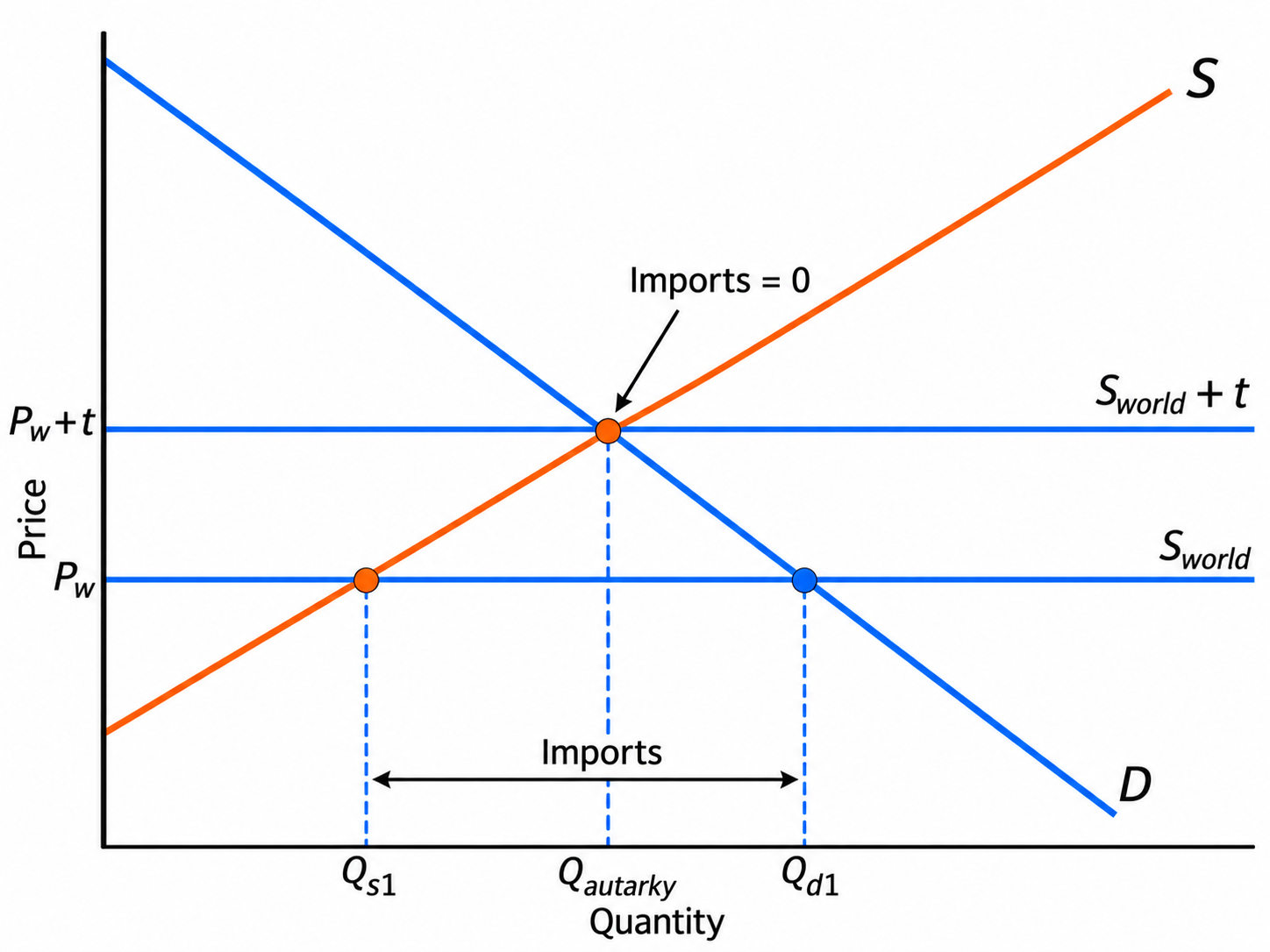
A prohibitive tariff eliminates the import gap. At Qautarky, domestic supply equals domestic demand, so imports are zero. If the tariff were raised still further, the domestic price would remain at the no-trade equilibrium rather than continuing to rise with Pw + t.
If the tariff were set even higher than this, the tariff-inclusive import price would lie above the no-trade equilibrium price, but the domestic price would remain at the no-trade equilibrium because no imports would take place.
What does this mean for Joanne?
Return to Joanne, the supermarket buyer from the first article.
In the standard tariff case, imported tomatoes now cost more to bring into Britain. Some of the market is therefore taken by British producers, while consumers buy fewer tomatoes overall.
But imports have not disappeared. Joanne is still buying some tomatoes from overseas — just fewer than before.
If the tariff became high enough to eliminate imports altogether, the supermarket would no longer buy imported tomatoes at all in this simplified model. The domestic market would instead settle at the no-trade equilibrium, where domestic supply equals domestic demand.
Real markets may be more complicated. Supermarkets may absorb some of the higher cost in their margins, suppliers may alter prices, contracts may delay the effect, and domestic and imported products may not be perfect substitutes.
The purpose of the diagram is not to reproduce every commercial decision Joanne might make. It is to isolate the central economic mechanism.
A common mistake: saying the world price rises
It is tempting to say that the tariff raises the world price from Pw to Pw + t.
But that is not what the standard small-country model is saying.
The world price remains Pw.
The tariff creates a wedge between the world price and the higher price faced in the domestic market.
So the better wording is:
The tariff raises the domestic price above the world price.
If the tariff becomes prohibitive, the domestic price eventually reaches the no-trade equilibrium price. A still higher tariff would not push the domestic price higher, because imports have already fallen to zero.
Another common mistake: shifting the curves
The tariff does not shift the domestic demand or supply curves in this model.
Instead, the higher domestic price causes movements along them.
Quantity supplied rises from Qs1 to Qs2.
Quantity demanded falls from Qd1 to Qd2.
So drawing a new domestic supply curve to the right, or a new demand curve to the left, would be a mistake.
What should you say in an exam?
A strong explanation could be:
A tariff raises the domestic price above the world price. This causes an expansion in quantity supplied by domestic producers and a contraction in quantity demanded by consumers. The gap between domestic demand and domestic supply therefore narrows, so imports fall. If the tariff is high enough, that gap can disappear completely and imports fall to zero.
That is stronger than simply writing:
A tariff reduces imports.
The first answer explains the mechanism.
The second only states the result.
The key idea
A tariff diagram is easiest to understand as a story about a narrowing import gap.
The tariff raises the domestic price.
At the higher price, domestic producers supply more and consumers buy less.
The gap between domestic demand and domestic supply becomes smaller, so imports fall.
If the tariff becomes high enough, the gap disappears altogether.
In the next article, we will use the same diagram to ask a different question:
Who Gains and Who Loses from a Tariff? Consumer Surplus, Producer Surplus and Welfare
Continue the Tariffs Learning Pathway
← Part 2 — World Price and Imports Explained: The Economics Before a Tariff