Microeconomics → International Trade → Tariffs | Part 4 of 4
The final part of our four-part tariff learning pathway. Explore how tariffs affect consumers, producers and government revenue, and use economic welfare analysis to evaluate who gains and who loses.
In the previous article, How Does a Tariff Work? The Tariff Diagram Explained, we saw what happens when a tariff raises the domestic price above the world price.
Domestic producers supply more.
Consumers buy less.
Imports fall.
Now we can ask a different question:
Who gains from those changes, who loses, and what happens to economic welfare overall?
The answer can be understood by dividing the welfare effects into four areas.
Start with the consumer
Before the tariff, consumers pay the world price, Pw.
After the tariff, the domestic price rises to Pw + t.
Consumers therefore lose in two ways:
they pay a higher price for the units they continue to buy;
some consumers stop buying altogether because the price has risen.
Consumer surplus falls.
But the important point is that not all of that lost consumer surplus disappears.
Some is transferred to domestic producers.
Some becomes government tariff revenue.
And some is lost altogether.
That is why the welfare diagram is best understood by breaking the consumer loss into four parts.
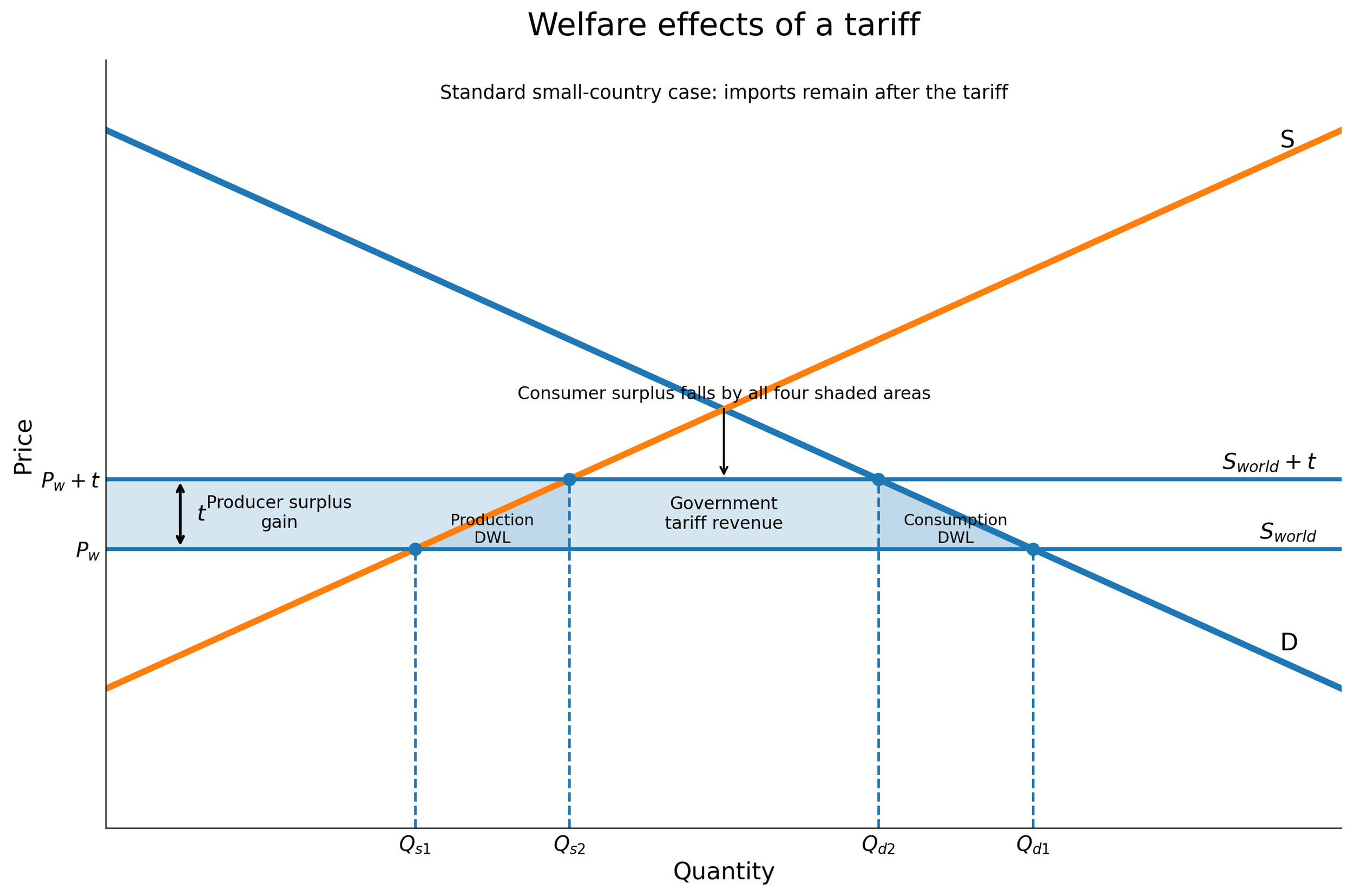
Area 1: domestic producers gain
The first shaded area is the gain in producer surplus.
Before the tariff, domestic producers receive Pw and supply Qs1.
After the tariff, they receive the higher domestic price Pw + t and expand output to Qs2.
They therefore gain because:
they receive a higher price on the output they were already producing;
they produce and sell additional units.
So part of the consumer loss has not vanished.
It has been transferred to domestic producers.
Consumers lose, but domestic producers gain producer surplus.
Area 2: the production deadweight loss
The next shaded area is different.
The tariff encourages domestic production to expand from Qs1 to Qs2.
But these extra domestic units cost more to produce than it would have cost to obtain equivalent units at the world price.
Without the tariff, those units would have been imported more cheaply.
The tariff therefore encourages resources into relatively higher-cost domestic production.
This creates the production deadweight loss.
A useful way to think about it is:
Why produce these extra units domestically when they could have been obtained more cheaply from abroad?
The answer is: only because the tariff has changed the price signal.
That is an efficiency loss, not a transfer from one group to another.
Area 3: the government gains tariff revenue
Imports have fallen, but they have not disappeared.
The government receives the tariff on every unit that is still imported.
So:
Government tariff revenue = tariff per unit × post-tariff imports
or:
t × (Qd2 − Qs2)
On the diagram, this is the rectangular shaded area between Qs2 and Qd2.
Again, this part of the consumer loss has not disappeared.
It has become government revenue.
So far we have:
a transfer from consumers to domestic producers;
a transfer from consumers to government.
But there is still one more shaded area.
Area 4: the consumption deadweight loss
The tariff raises the price and causes consumption to fall from Qd1 to Qd2.
The consumers between Qd2 and Qd1 would have bought the product at the world price.
They do not buy it once the tariff raises the domestic price.
For those units, consumers were willing to pay more than the world cost of obtaining the product.
Without the tariff, those trades would have taken place.
With the tariff, they do not.
This creates the consumption deadweight loss.
So the second efficiency problem is:
Too little consumption takes place because the tariff has pushed the domestic price above the world cost.
Put the four areas together
We can now account for the whole fall in consumer surplus.
Part becomes:
higher producer surplus
Part becomes:
government tariff revenue
But two parts are not received by anyone:
the production deadweight loss
the consumption deadweight loss
Those two triangles are the net loss of economic welfare.
So:
Consumer loss = producer gain + government revenue + two deadweight-loss areas
And therefore:
Net welfare loss = production deadweight loss + consumption deadweight loss
That is the central result of the standard small-country tariff model.
Why don't the gains offset the losses?
This is often where students get confused.
Domestic producers gain.
The government gains revenue.
So why is there still a welfare loss?
Because the consumer loss is larger than those two gains combined.
The difference is represented by the two deadweight-loss triangles.
Some of the consumer loss is simply redistributed.
But some of it disappears as economic surplus.
That is why the tariff reduces total welfare in this model.
Does this mean tariffs are always a bad idea?
No.
The diagram answers a narrower question:
What happens to economic surplus in the standard small-country model?
Within that model, the tariff creates a net welfare loss.
But governments may have other objectives, such as protecting strategic industries, supporting employment, responding to dumping, reducing dependence on foreign suppliers or pursuing national-security goals.
Those arguments have to be evaluated separately.
The diagram does not prove that every tariff is undesirable.
It shows that protection has an economic cost within this particular model.
What does this mean for Joanne?
Return to Joanne, the supermarket buyer from our earlier articles.
After the tariff:
British tomato growers benefit from the higher domestic price;
the government receives revenue on the tomatoes Joanne still imports;
customers pay more and buy fewer tomatoes;
some tomatoes that were previously sourced more cheaply from overseas are now produced domestically at a higher resource cost.
The welfare diagram turns Joanne's commercial problem into a broader economic question:
What has happened to the gains from trade?
What should you say in an exam?
A strong explanation could be:
A tariff raises the domestic price above the world price, reducing consumer surplus. Domestic producers gain producer surplus because they receive a higher price and expand output, while the government receives tariff revenue on the imports that remain. However, these gains do not fully offset the loss of consumer surplus. The tariff creates production and consumption deadweight losses, so total economic welfare falls in the standard small-country model.
That is much stronger than simply writing:
Tariffs cause a welfare loss.
The first answer explains where the welfare loss comes from.
The key idea
The welfare effects of a tariff are easiest to understand by asking what happens to the consumer surplus that is lost when the price rises.
Some goes to producers.
Some goes to the government.
But some goes to nobody.
Those missing areas are the deadweight welfare losses.
So the central result is:
The gain to domestic producers plus government tariff revenue is smaller than the loss suffered by consumers. The difference is the deadweight welfare loss.
You've completed the Tariffs Learning Pathway!
You can now revisit earlier articles, explore other Economics topics or practise applying what you've learned to unfamiliar situations.
← Part 3 — How Does a Tariff Work? The Tariff Diagram Explained