Microeconomics → Government Intervention → Subsidies | Part 3 of 7
Part 3 of our seven-part subsidy learning pathway. Discover how price elasticity determines how the benefits of a subsidy are shared between producers and consumers.
In our previous articles, we followed Luke, a dairy farmer who receives a government subsidy of 5p for every litre of milk he sells.
Before the subsidy, processors paid 40p per litre. Afterwards, processors paid 38p, while farmers received 43p altogether, including the subsidy.
Farmers gained 3p per litre, while processors saved 2p.
But why was the subsidy shared this way? Could farmers have received more, or processors benefited more?
Yes. It depends on how responsive buyers and sellers are to changes in price.
1. Who actually benefits from a subsidy?
Although the government pays the subsidy to farmers, they don't necessarily keep the whole benefit.
The subsidy encourages farmers to produce more milk, which pushes down the price processors pay.
In Luke's example, farmers gain 3p per litre and processors save 2p. Together, these account for the 5p subsidy.
Economists call the way the benefit is shared between buyers and sellers the incidence of a subsidy.
The division depends on the price elasticity of demand and supply: how much buyers and sellers change the quantities they buy or sell when prices change.
2. What happens when demand is more or less elastic?
Suppose processors don't buy much more milk when its price falls.
Demand is relatively price inelastic. Because processors don't respond much to lower prices, the price must fall further to encourage them to buy the additional milk farmers produce.
Processors therefore receive a larger share of the subsidy.
Now suppose processors are very responsive to price changes.
Demand is relatively price elastic. A smaller price reduction encourages them to buy considerably more milk, so farmers retain more of the subsidy.
These comparisons assume the elasticity of supply stays the same.
3. What happens when supply is more or less elastic?
Now consider the farmers.
If farmers can increase production easily, supply is relatively price elastic. The subsidy encourages a substantial increase in output, pushing down the price processors pay. Processors receive more of the benefit.
But if farmers find it difficult to increase production, supply is relatively price inelastic. The quantity supplied increases less, so the price paid by processors falls by less. Farmers retain more of the subsidy.
These comparisons assume the elasticity of demand stays the same.
4. What does this look like on a diagram?
We can illustrate the difference with two subsidy diagrams.
In both diagrams, P₁ is the original market price, Pₛ is the price farmers receive including the subsidy, and Pᵦ is the price processors pay after the subsidy. Q₁ and Q₂ show the quantities before and after the subsidy.
We're using symbols rather than actual prices because the outcome depends on the elasticities of supply and demand.
Diagram A — Inelastic demand, elastic supply
Demand is relatively steep and supply relatively shallow. Processors receive a larger share of the subsidy because the price they pay falls further.
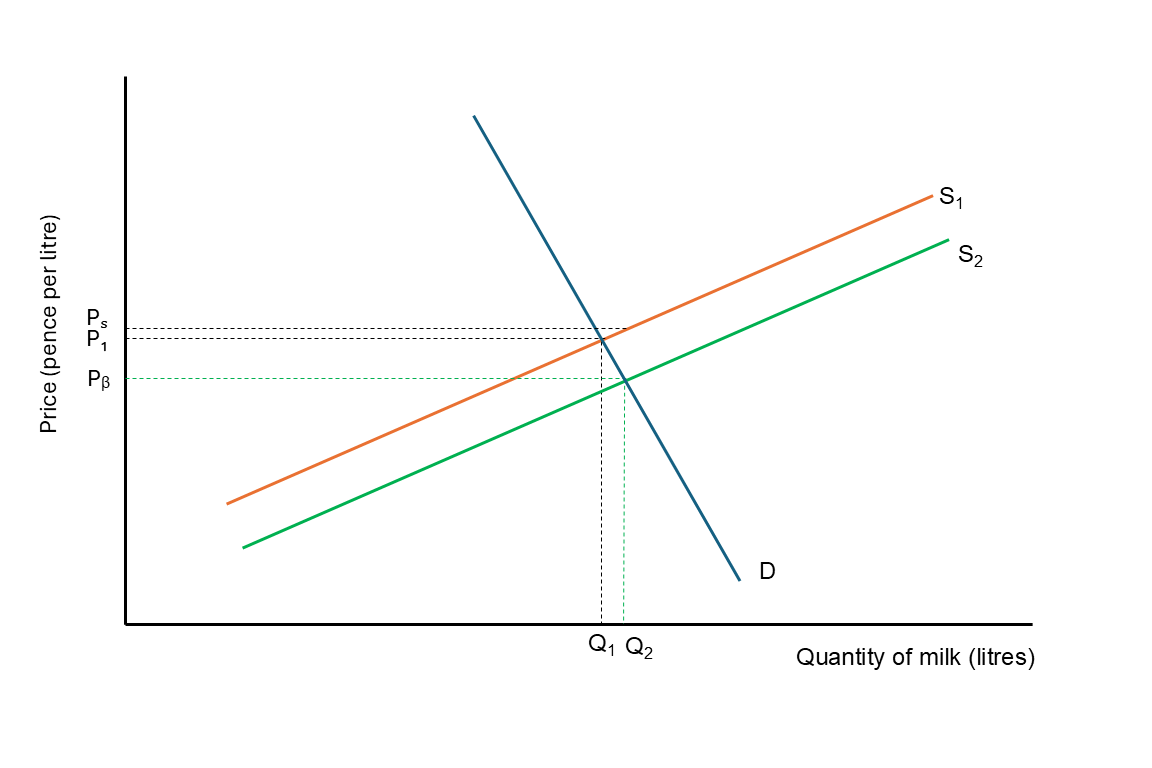
Diagram B — Elastic demand, inelastic supply
Demand is relatively shallow and supply relatively steep. Farmers receive a larger share because the price processors pay falls by less.
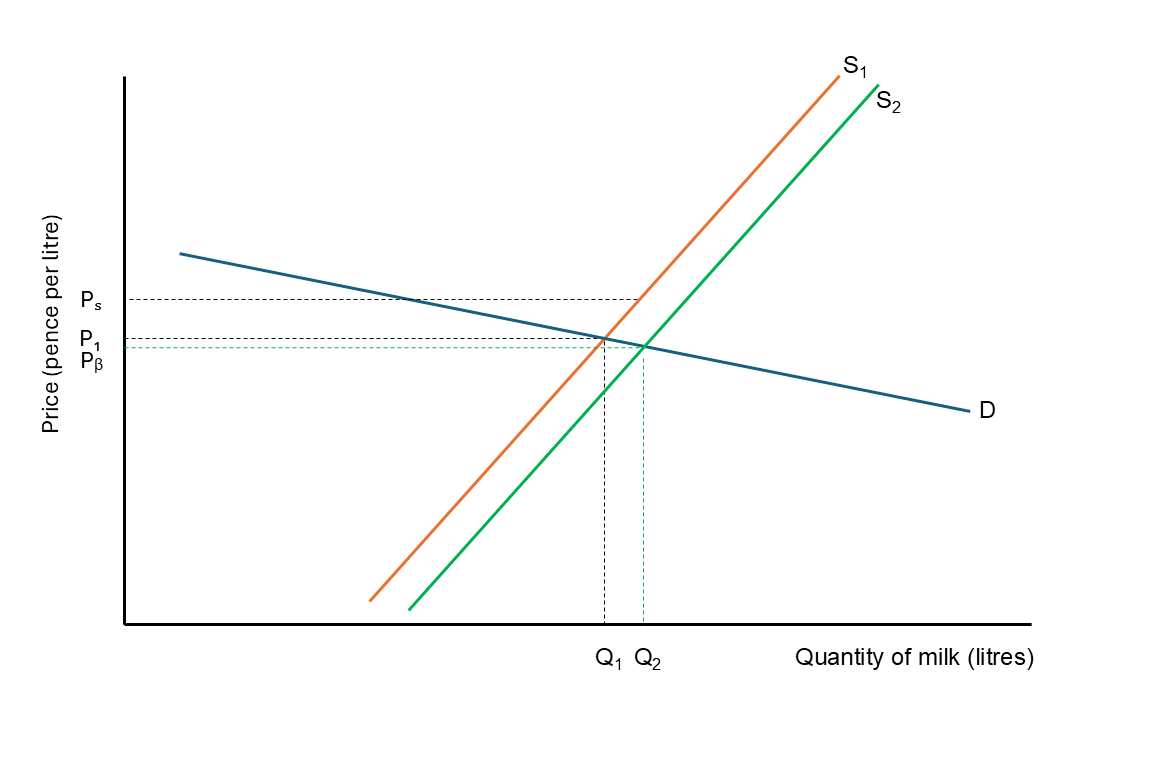
In both cases, the vertical difference between what farmers receive and what processors pay equals the subsidy of 5p.
What changes is how that 5p is divided.
We've drawn two different diagrams, each showing a possible way the subsidy might be shared.
But which one is more realistic for Luke's dairy farm?
We can't tell simply by drawing the curves.
Economists would need evidence about how farmers and processors respond to changing prices. For example, how much additional milk could farmers produce if the price they received increased? And how much more milk would processors buy if their price fell?
The answers might also change over time. Luke cannot suddenly acquire more cows or build a larger barn, but he may be able to expand production over several years. Supply could therefore be less price-elastic in the short run than in the long run.
The diagrams help us understand why elasticity matters. They don't tell us what the actual elasticities are.
That is why economists need real-world evidence as well as models.
5. Does it matter who receives the payment?
We've assumed the government pays farmers directly.
But suppose it paid processors instead.
In the standard competitive market model, the final outcome would be the same. The benefit would still be divided according to the relative elasticities of demand and supply.
Who receives the payment isn't necessarily who receives the economic benefit.
In practice, market power and contracts may affect the outcome.
6. Do supermarket shoppers benefit too?
Our diagrams show the market for raw milk sold by farmers to processors.
Processors benefit from paying less for milk. But that doesn't necessarily mean supermarkets or shoppers will benefit.
Whether lower costs are passed on depends on competition, contracts and pricing decisions further along the supply chain.
What have we learned?
A subsidy paid to farmers can benefit both farmers and processors.
The less price-responsive side of the market tends to receive a greater share of the subsidy.
This is why understanding elasticity helps economists explain who gains from government intervention.
In the next article, we'll ask: who actually pays for the subsidy?
Continue the Subsidies Learning Pathway
← Part 2 — The Subsidy Diagram Explained: Step by Step
Part 4 → Who Pays for a Subsidy?