Microeconomics → Government Intervention → Subsidies | Part 5 of 7
Part 5 of our seven-part subsidy learning pathway. Explore when subsidies improve economic welfare, when they create inefficiency, and how externalities affect the judgement.
In our previous articles, we met Luke, a dairy farmer who receives a government subsidy of 5p for every litre of milk he sells.
We saw how the subsidy encourages farmers to produce more milk, while both farmers and processors benefit financially.
But does the subsidy make society better off?
If a market is already working efficiently, a subsidy that increases production will reduce economic welfare. If the market isn't working efficiently, a subsidy might improve welfare.
Let's see why.
1. What happens if the market is already efficient?
Before the subsidy, milk sells for 40p per litre. At that price, the amount farmers want to sell equals the amount processors want to buy.
Now make an important assumption: the milk market is competitive, with no externalities or other market failures.
Under these conditions, the market produces the socially efficient quantity of milk.
What does that mean?
Imagine the last litre produced before the subsidy. It costs 40p to produce, and buyers value it at 40p. The benefit equals the cost.
Producing more milk would be different.
The additional litres would cost more than 40p to produce, but buyers would only be willing to pay less than 40p for them.
In other words, the additional milk would cost society more to produce than it was worth to buyers.
That's why the original quantity was efficient.
2. What changes when the government introduces the subsidy?
Luke and other farmers now receive 5p from the government for every litre they sell.
This encourages them to increase production.
As we saw in Article 2, the price paid by processors falls to 38p, while farmers receive 43p altogether.
At the new equilibrium, the last litre costs 43p to produce, but buyers value it at only 38p.
The government pays the 5p difference.
But notice something important.
The subsidy hasn't made that additional milk worth 43p to society. Nor has it reduced the resources needed to produce it.
It has simply made production financially worthwhile for farmers.
Under our assumptions, the additional production uses resources whose cost exceeds the benefit they generate.
Economists call the resulting loss of economic welfare a deadweight welfare loss.
3. But don't farmers and processors both benefit?
Yes. Farmers receive more per litre, and processors pay less.
In economic terms, the subsidy increases producer surplus and consumer surplus in the market for raw milk.
However, the government also has to finance the subsidy.
To calculate the overall change in economic welfare, economists compare the gains to buyers and sellers with the government's expenditure:
Change in total welfare = Change in consumer surplus + Change in producer surplus − Government expenditure
In our example, the combined gains to farmers and processors are smaller than the amount the government spends.
The difference is the deadweight welfare loss.
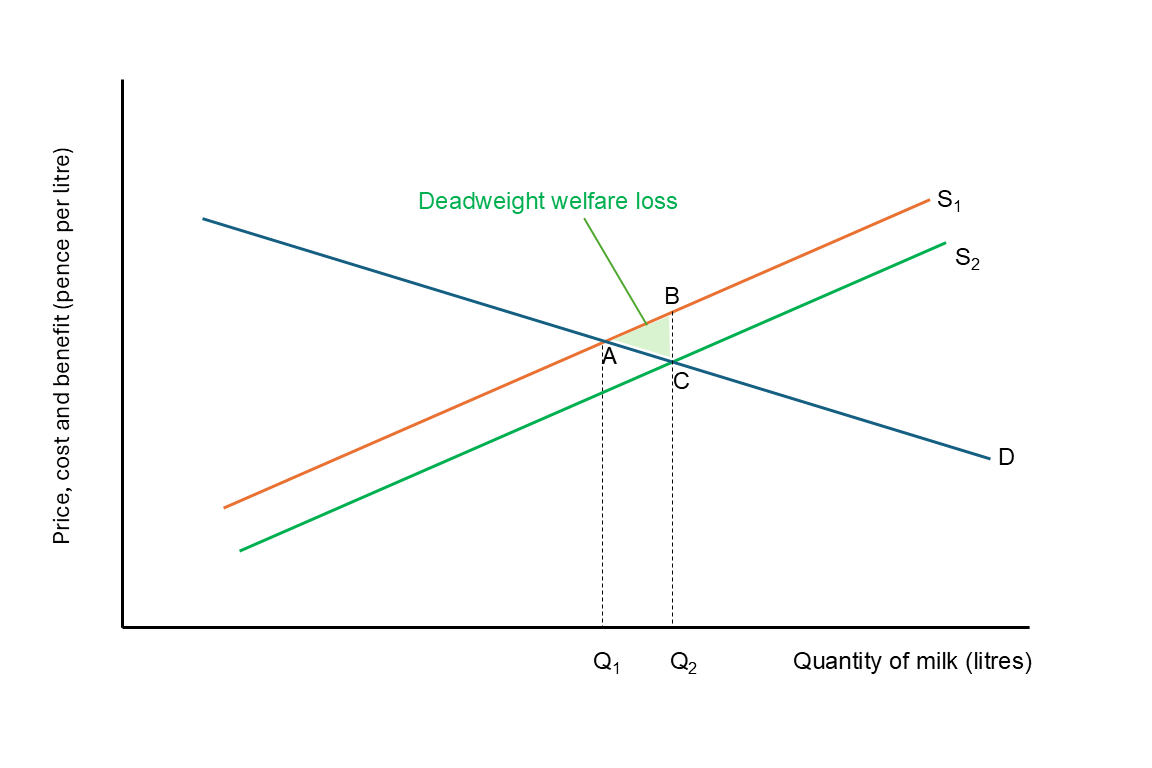
The government's total expenditure isn't itself the welfare loss. Much of that expenditure transfers purchasing power to farmers and processors.
The welfare loss arises because the subsidy encourages production beyond the efficient quantity.
4. When might a subsidy improve welfare?
Now imagine a different situation.
Suppose a business is paid to plant trees on people's land. The customers benefit from having trees, but the trees may also provide wider benefits, such as improving wildlife habitats or absorbing carbon dioxide.
These wider benefits aren't fully reflected in the price customers pay for the tree-planting service.
Economists call this a positive externality of production: producing the service generates benefits for people who aren't directly involved in the transaction.
Because some of the benefits aren't reflected in the market price, the business may produce fewer trees than would be best for society.
In this case, a subsidy could encourage additional production that is worth more to society than it costs.
The important difference is that the market was not producing the socially efficient quantity in the first place.
Economists distinguish between marginal private cost (MPC), which producers consider, and marginal social cost (MSC), which also accounts for external effects.
In this simplified example, MSC lies below MPC because producing and planting additional trees creates external benefits.
A suitably designed subsidy could move production towards the socially efficient quantity.
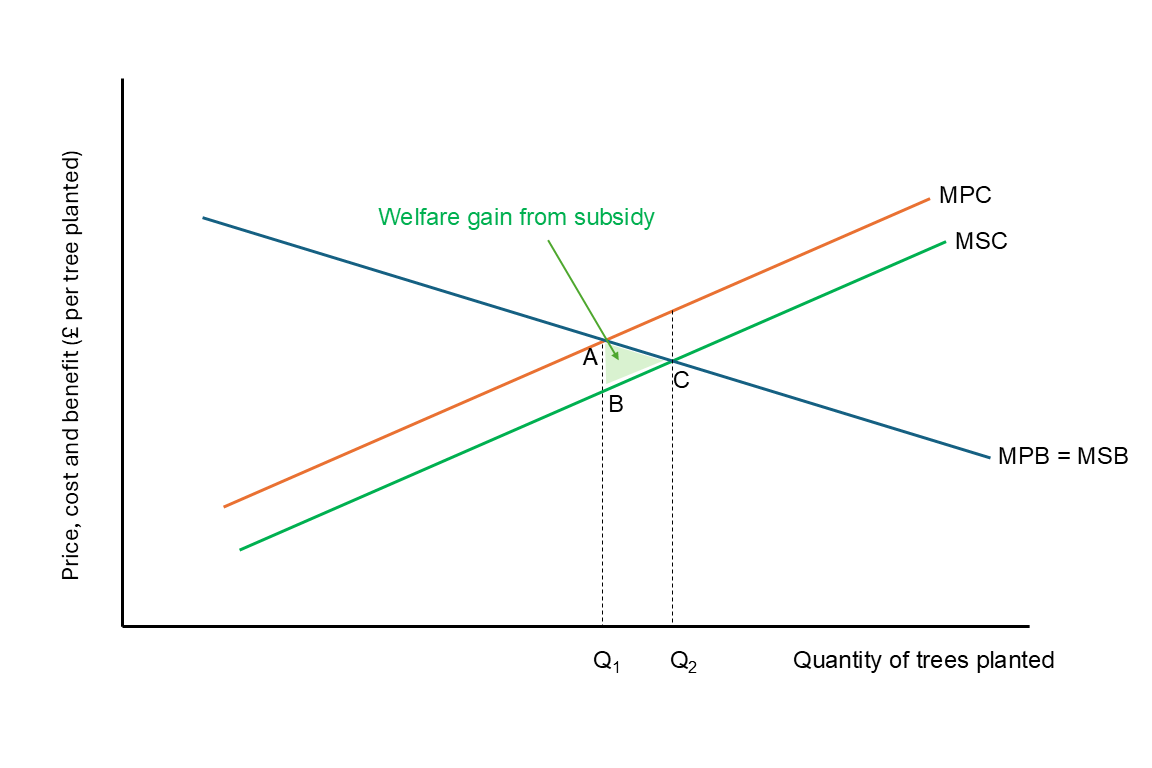
But the subsidy would need to be appropriately targeted and sized. Too much subsidy could encourage excessive production.
When agricultural support creates unintended consequences
During the 1970s and 1980s, Europe's Common Agricultural Policy became associated with enormous surpluses of butter and milk products — the famous butter mountains and milk lakes.
The policy supported farmers through arrangements including guaranteed prices and public purchases of surplus produce. These encouraged production that exceeded the quantities consumers wanted to buy at the supported prices.
The result included expensive storage of agricultural surpluses.
These arrangements weren't identical to Luke's 5p-per-litre subsidy. But they illustrate an important economic principle: a policy intended to support producers can encourage more production than society needs, creating unintended costs.
The lesson isn't that all agricultural support is harmful. It's that the design of a policy matters.
5. Does that justify Luke's subsidy?
Not necessarily.
Suppose the government argues that dairy farming helps preserve attractive rural landscapes. Well, that might be true. But would producing another litre of milk preserve more landscape?
Luke might increase production simply by feeding his existing cows differently or keeping more cows in the same buildings. If so, the additional milk might produce no additional landscape benefit. It might even create environmental costs.
So demonstrating that dairy farming provides some wider benefit doesn't establish that subsidising every litre of milk improves welfare.
If the objective is to preserve hedgerows or grassland, paying farmers directly for maintaining them might be more effective.
And what if the main problem is that farmers receive low prices because milk buyers have substantial bargaining power? In that case, the government might consider measures to improve competition or strengthen farmers' negotiating position instead. Whether those measures would work better than a subsidy would depend on the evidence.
And the government would need reliable information about the benefits, costs and likely responses. Otherwise, even a well-intentioned subsidy could have unintended consequences.
This is one reason economists study government failure: intervention intended to improve an outcome can sometimes make it worse.
What have we learned?
A subsidy doesn't automatically improve economic welfare simply because farmers and processors benefit.
If a competitive market is already efficient, a subsidy that increases production creates a deadweight welfare loss.
If a market is inefficient because of a positive externality, a suitably designed subsidy may improve welfare.
But the existence of a theoretical justification doesn't prove that a particular subsidy will work.
To evaluate Luke's subsidy, we need to ask what problem the government is trying to solve, whether the subsidy addresses that problem, and whether its benefits justify its costs.
A subsidy diagram shows what happens under certain assumptions. It doesn't establish whether the policy is justified in practice.
Continue the Subsidies Learning Pathway
← Part 4 — Who Pays for a Subsidy?
Part 6 → Types of Subsidies: How Do They Work in Different Industries?